🇬🇧 Demoiselle damselflies
What do you do on hot summer’s days when the sun is beating down from a cloudless sky and the thermometer has already hit the 30-degree mark by 10 o’clock in the morning? Exactly - you stay at home! But then, unfortunately, that would be the end of the story – and knowing you lot, you’d rather read a bit more and have a look at some lovely pictures - right?! (Yeah, yeah - let Markus sweat it out - we’ll just sit back and enjoy the results with a nice cold beer...)
Never mind - there’s no point in complaining: unfortunately, some ideas can only be put into practice under precisely these conditions, even if the temperatures could have been a bit lower.
But what drives a photographer outdoors at midday in such photographically disastrous conditions? Well… as I hinted at above: a very specific image in mind! The image that had been taking shape in my mind’s eye for several weeks was that of a demoiselle damselfly perched on a stone, with the glistening stream in the background. I knew it had to be a monochrome image – either in dark shades of blue or even entirely in black and white. And as an added challenge, I’d love to capture a shot of a demoiselle damselfly taking flight, where you can see all four wings! (You can never set your goals high enough, after all...)
But even before you get round to the actual photography, there are already some initial hurdles to overcome: find a stream that carries enough water at this time of year, which ripples gently over small stones in places, and where the sun can shine unobstructed (i.e. without a canopy of leaves getting in the way) onto the water. The last two conditions are crucial for the bubbles, because without them my photographic concept won’t work. Only when the sun shines on the little ‘rapids’ and you position them in the background of your subject do the bubbles I’m looking for appear.
As is so often the case, I spent ages poring over maps looking for suitable locations. As is so often the case, I realised that it isn’t actually that easy to find a suitable spot in our region for the image I had in mind. Then, however, I remembered a spot I knew from one of my walks, which is also easily accessible by car. It was worth a try - so I drove there. And what can I say? A real hit! The photographic conditions could hardly have been better.
Now all I needed was for my subjects to play their part. I watched as the demoiselle damselflies chased one another to defend their territory and was delighted to discover that there were a few stones in the stream which the dragonflies kept using as perches from which to keep an eye out for unwelcome rivals. With the help of a small tripod, I positioned my camera, fitted with a fast telephoto lens, just above the water’s surface, so that the reflections of the bubbling water formed the background to my intended subject. Now it was a case of keeping still and waiting for a demoiselle damselfly to alight on the targeted rock.
As demoiselle damselflies are very loyal to their haunts and keep returning to their favourite spots, I had plenty of good opportunities to bring my photographic ideas to life in no time at all. Only the shot of the demoiselle damselfly taking off with all four wings spread - that didn’t work out, unfortunately. Who knows - maybe next time...
Here’s another little tip: you should definitely take a series of shots, as the arrangement of the bubbles in the background changes every time you press the shutter. And ultimately, it’s the right arrangement of the bubbles that determines whether you end up with a nice or an outstanding photo, because the background is part of the overall composition of a picture. If the background isn’t right, even the most beautiful subject is of no use!
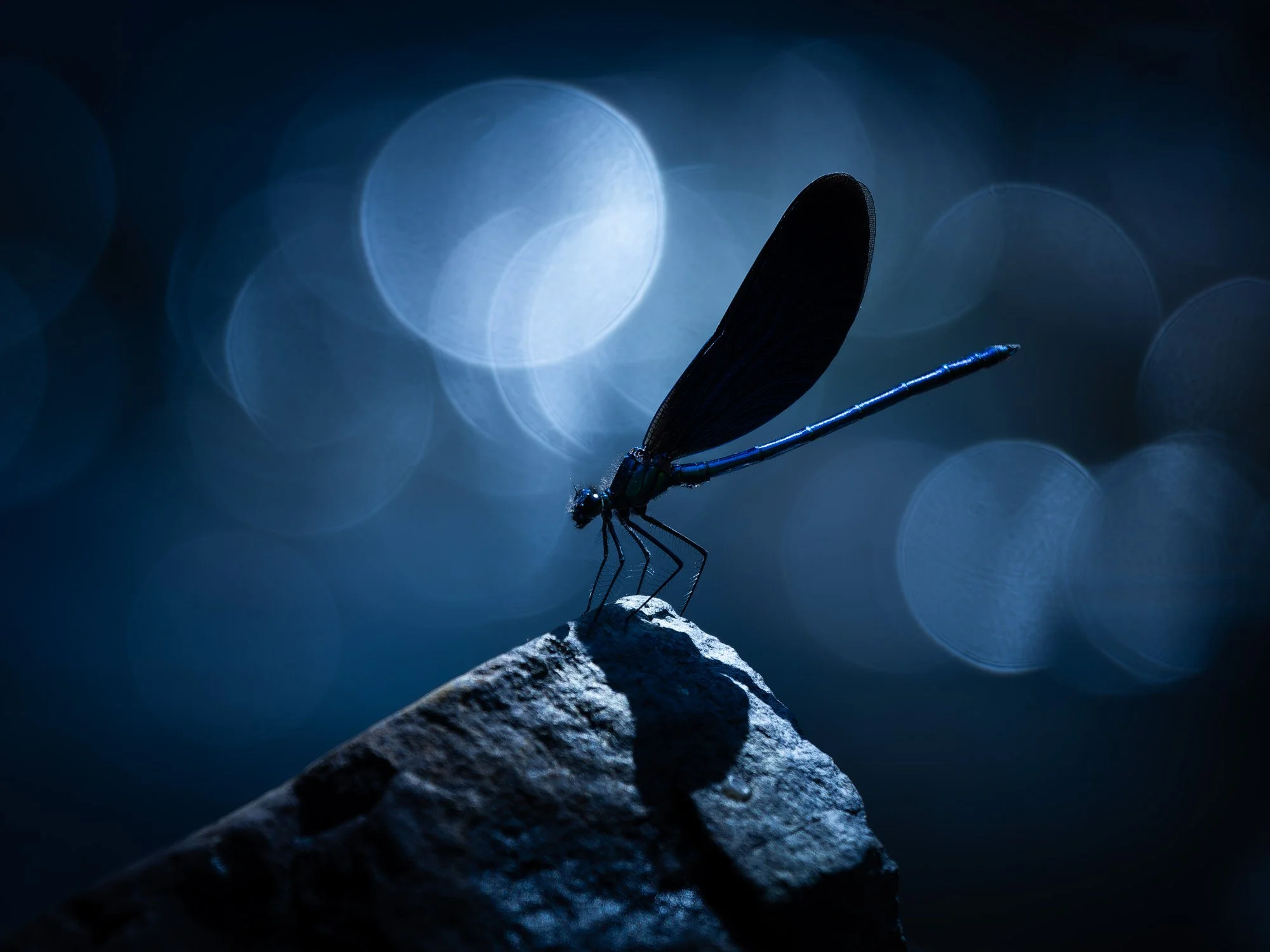
Dream shot no. 1: The ‘witching hour’ in photography – that is, at 12 noon…
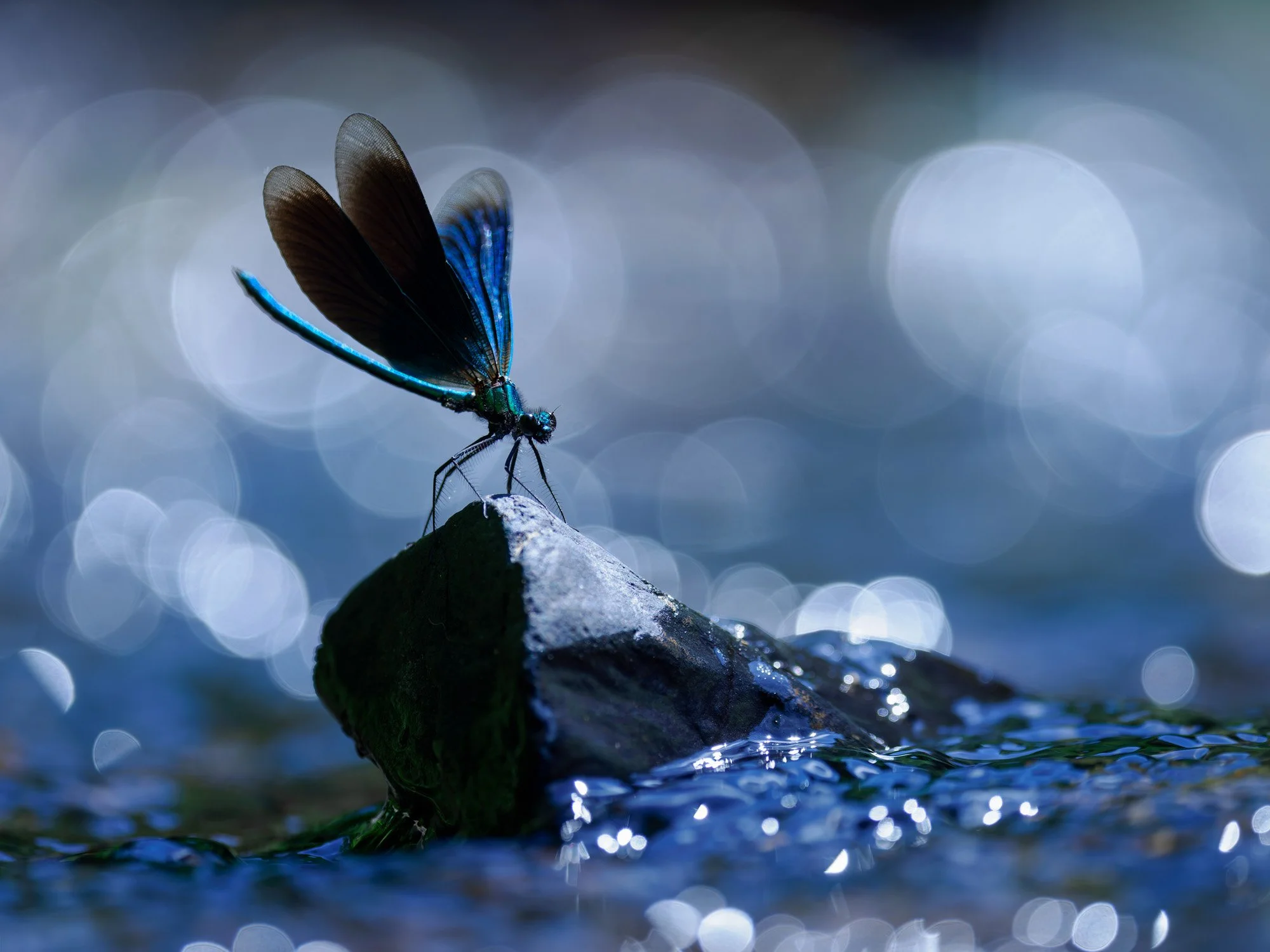
Dream shot no. 2: You can make out more than two wings.
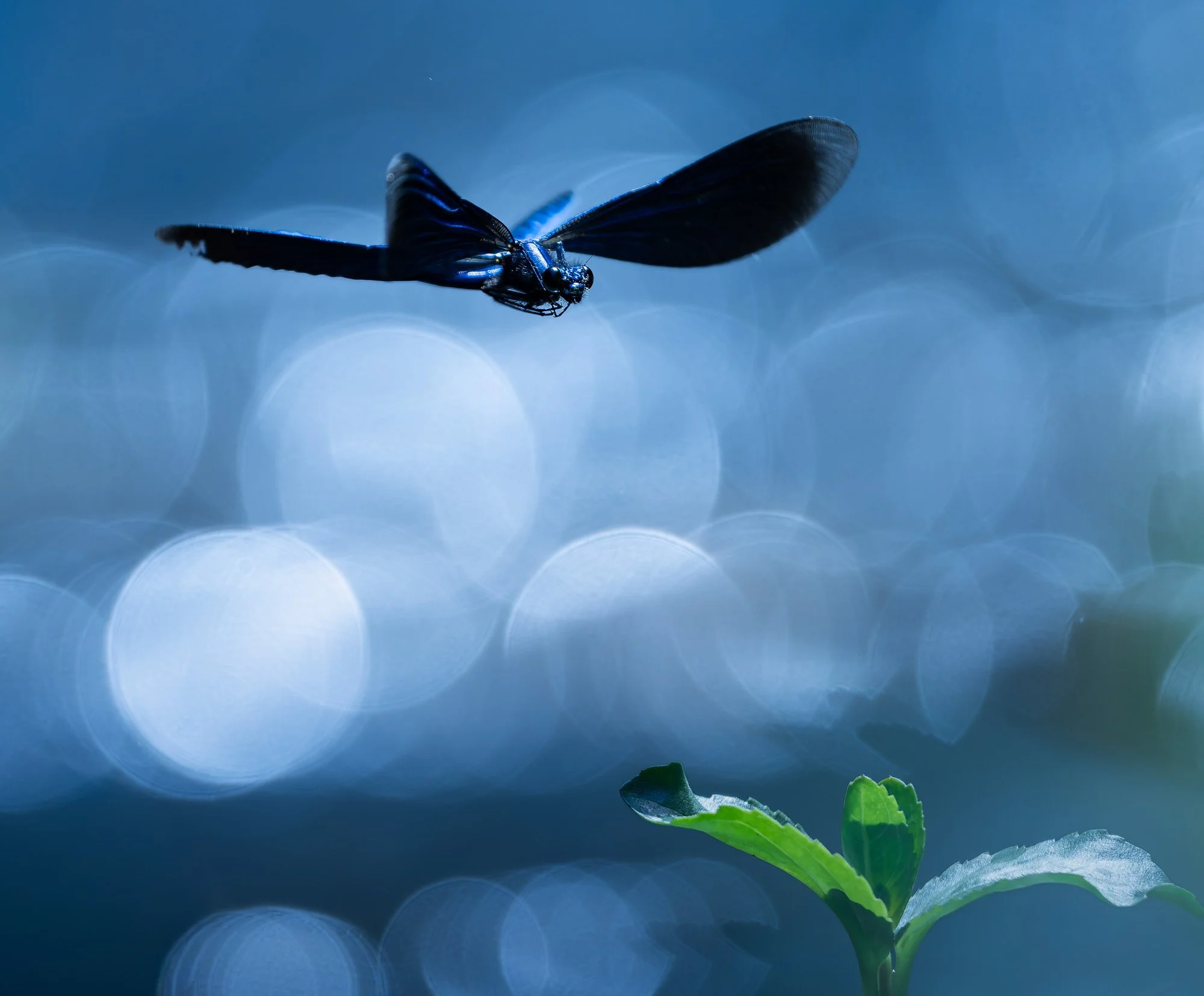
The only sharp photo of a male demoiselle damselfly taking flight – unfortunately without the typical wing position
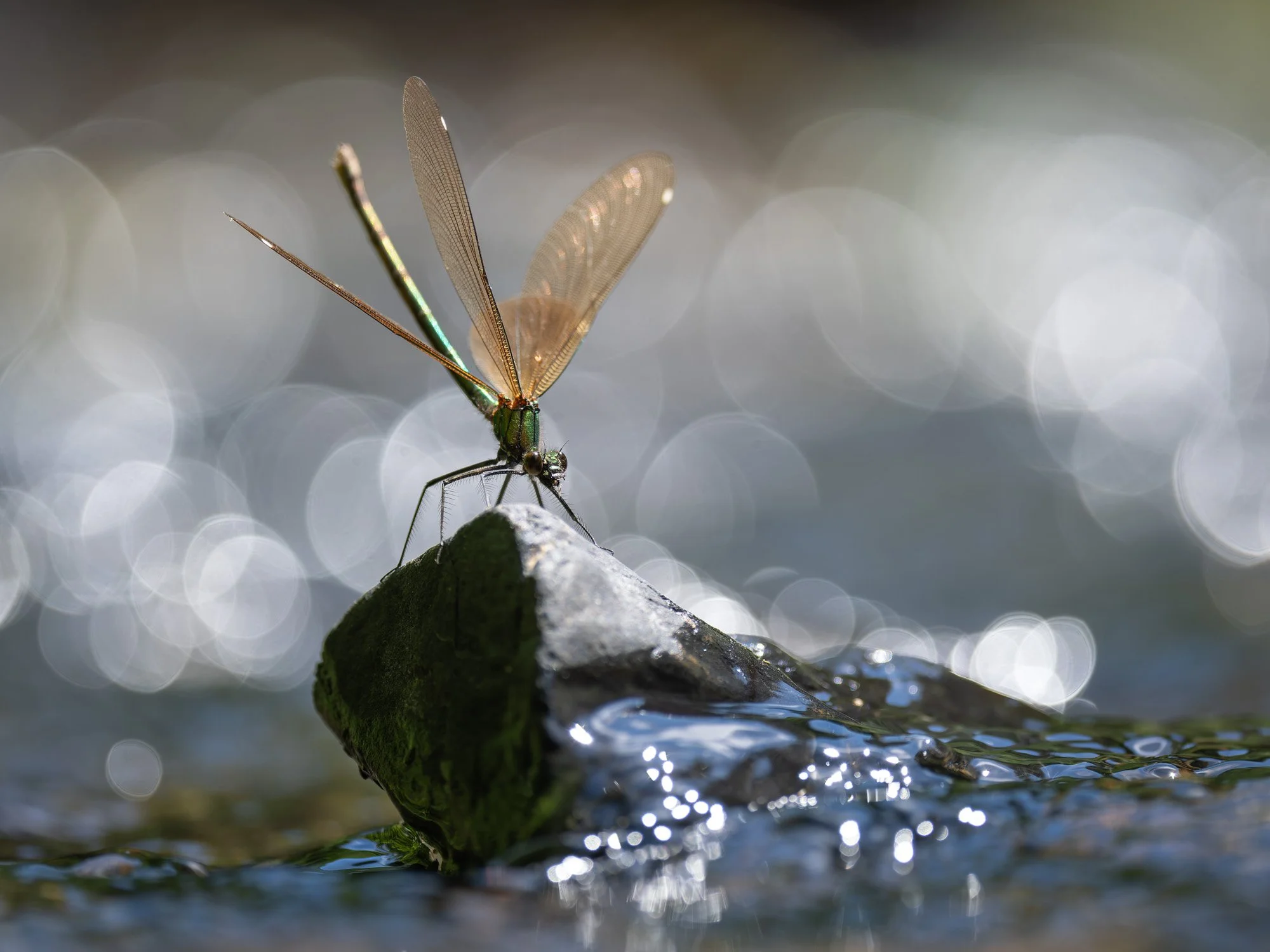
By-catch – female demoiselle damselfly
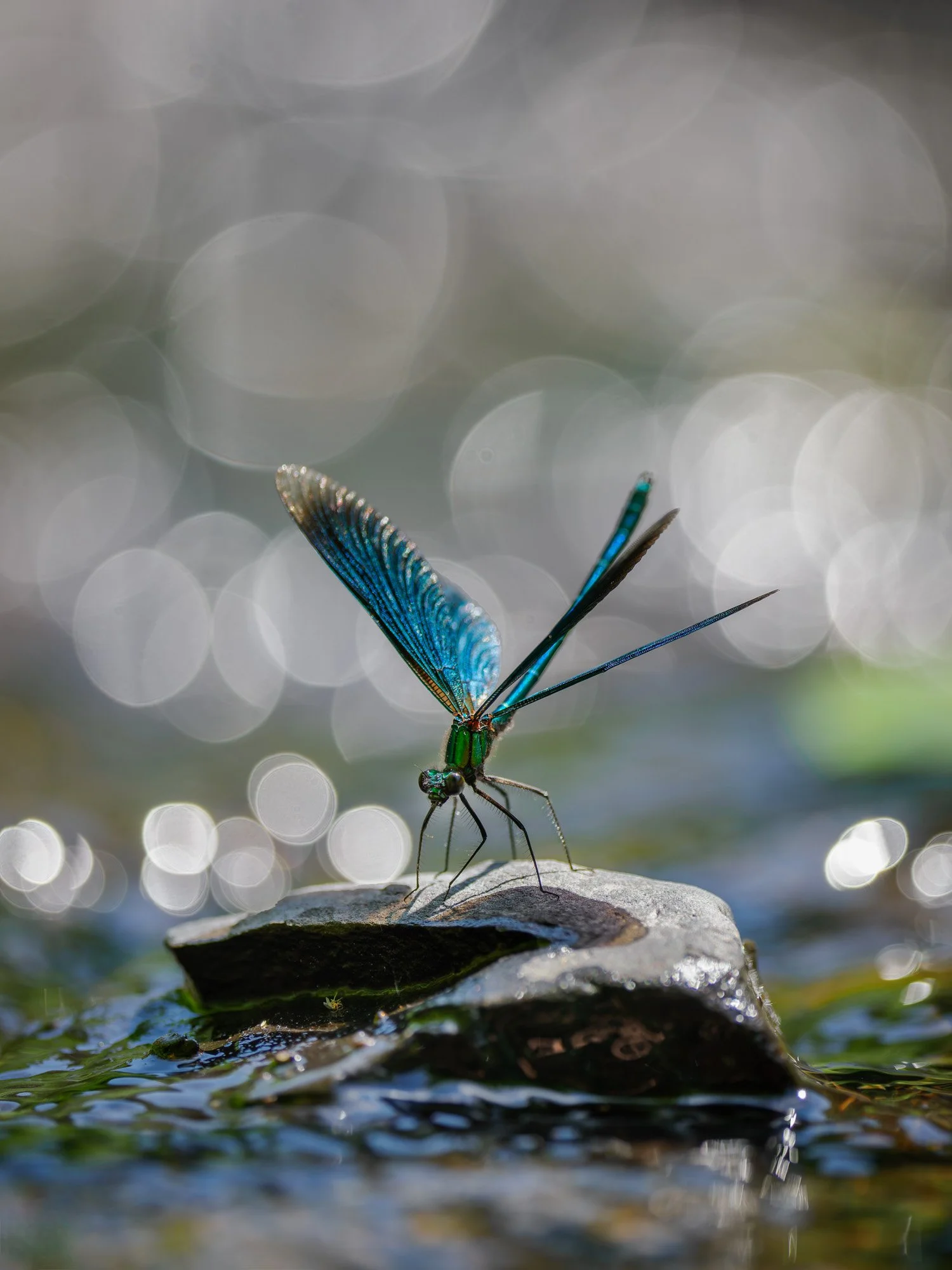
Male demoiselle damselflies usually appear dark blue-black. However, in the right sunlight, they reveal their full spectrum of colours.